 Years 4–6
Years 3–5Maths at school
Column addition and subtraction: how schools teach it
Lining numbers up in columns is the written method most parents remember. What has changed is the language, and the way schools build up to it with objects and pictures before a child writes a single carried digit.
Illustration: Quizo School
- Year 3column methods named, for numbers up to 3 digits
- Year 4the same methods with 4-digit numbers
- Year 5numbers with more than 4 digits
- Exchangingwhat many schools now call borrowing
What it is and when it appears
- Its name is columnar addition and subtraction. The National Curriculum calls them "the formal written methods of columnar addition and subtraction". Children write one number under the other with the ones, tens and hundreds lined up, and work from the right.
- Year 3 is the first year it is named. From Year 3 pupils add and subtract numbers with up to three digits this way, then four digits in Year 4 and larger numbers in Year 5. The Year 2 guidance already suggests recording sums in columns to support place value.
- Place value comes first. Before the written method, many schools use base-ten blocks, place value counters or a place value chart, so a child can see that the 1 they carry is really ten ones swapped for one ten.
- Exchanging is the new word for borrowing. When the top digit is too small, the child exchanges one ten for ten ones, or one hundred for ten tens. The number hasn't changed, only how it is split, so nothing is "paid back". Carrying in addition is often described the same way.
- Mental methods still matter. The written method is for numbers too big to hold in your head. Children are still expected to work out 46 + 30 or 100 − 98 mentally, so a teacher may ask: did you need the column method for that?
Worked examples
Column addition: 367 + 258
- Ones: 7 + 8 = 15. Write 5 in the ones column and carry the ten: a small 1 in the tens column.
- Tens: 6 + 5 = 11, plus the carried 1 makes 12 tens. Write 2 and carry 1 into the hundreds.
- Hundreds: 3 + 2 = 5, plus the carried 1 makes 6.
- Answer: 625. Check with an estimate: about 370 + 260 = 630, so 625 makes sense.
Column subtraction with exchanging: 532 − 178
- Ones: 2 − 8 can't be done, so exchange one ten for ten ones. The tens go from 3 to 2 and the ones become 12. 12 − 8 = 4.
- Tens: there are now 2 tens, and 2 − 7 can't be done, so exchange one hundred for ten tens. The hundreds go from 5 to 4 and the tens become 12. 12 − 7 = 5.
- Hundreds: 4 − 1 = 3.
- Answer: 354. Check by adding back: 354 + 178 = 532.
How to help at home
“That's not how I learnt it”
You may have learnt to borrow and pay back, or to write the carried digit somewhere else. Before you show your way, ask your child to teach you theirs and say what each step means. If it gets the right answer and they can explain it, stick with it.
A 10-minute activity: the receipt game
Take an old receipt or a price list. Pick two prices, your child estimates the total, then adds them in columns. Then work out the change from £10 or £20 with column subtraction. Use whole pounds or pence for younger children, pounds and pence once they have met decimals at school.
Say what each digit is worth
Ask "What is that 6 really worth?" (sixty). Saying tens and hundreds out loud keeps the method tied to the numbers rather than to a trick with digits.
Estimate first
Round both numbers and guess the answer before writing anything. A quick estimate catches most slips.
Common mistakes
- Lining up from the left. Writing 45 under 367 with the 4 under the 3. Start from the ones, and use squared paper so each digit has its own box.
- Taking the smaller digit from the bigger one. In 532 − 178, writing 8 − 2 = 6 in the ones. Ask: is the top digit big enough? What can we exchange?
- Forgetting the carried digit. Writing 615 instead of 625. Encourage your child to write the carry in the same place every time and tick it off once it is used.
- Exchanging across a zero. In 403 − 167 there are no tens to exchange. Exchange a hundred for ten tens first, then one of those tens for ten ones: the answer is 236. Drawing dots or using blocks helps.
Practise and explore on Quizo School
- Year 3: Column addition The lessons that introduce the written method for addition.
- Year 3: Column subtraction Exchanging step by step, with up to three digits.
- Year 4: Column addition and subtraction with 4-digit numbers The same methods with bigger numbers.
- Year 3 Maths Every Year 3 maths unit, lesson and quiz.
- Number lines Counting on, the other way to find a difference.
- Today's 10 Ten questions a day, built from your child's mistakes.
Questions parents ask
Should the carried 1 go above or below the line?
Either works. Schools choose one place and keep to it, so use whatever your child's teacher uses.
My child counts on along a number line instead. Is that wrong?
No. For numbers close together, such as 403 − 387, counting on is often quicker and more reliable. Columns are for numbers too large to work out comfortably in your head.
Why do schools avoid the word borrowing?
Because nothing is given back. Exchanging says what really happens: one ten is swapped for ten ones, and the number stays the same.
Does the method change at secondary school?
No. The same column methods carry on into Key Stage 3, including with decimals, which children first line up by the decimal point in Year 5.
A little maths every day
Today's 10 picks ten questions a day for your child, starting with what they got wrong before. It is part of the Family plan. New families get the Family plan free for 14 days, with no card needed.
Start freeWas this page helpful?
Related guides
Years 4–6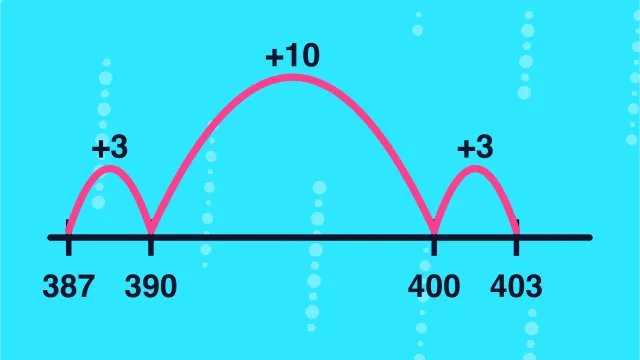 Years 1–6
Number lines: counting on, differences and fractions
Read the guide Years 1–6