 Years 4–6
Maths at school
Short and long division (the bus stop): a guide for parents
Children call it the bus stop because the number being divided waits under a shelter. The method is not new; what surprises many parents is when it arrives, how remainders are written and the long division that follows in Year 6.
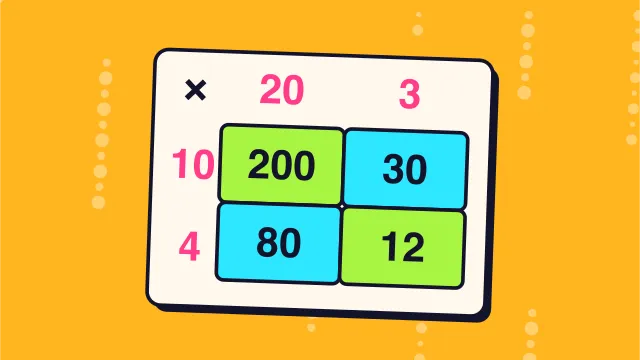
Illustration: Quizo School
- Year 4when many schools introduce short division
- Year 5short division up to 4 digits by 1 digit, with remainders
- Year 6long division by a 2-digit number
- 3 waysto write a remainder: whole number, fraction or decimal
What it is and when it appears
- Short division is the bus stop. The number being divided goes under the shelter, the number you divide by waits outside, and the answer is written on the roof. Each step divides one digit and carries what is left over to the next.
- It is in the Year 5 programme of study. The National Curriculum asks for "the formal written method of short division" for numbers up to four digits divided by a one-digit number in Year 5. Many schools introduce the bus stop earlier, in Year 4, with answers that divide exactly.
- Long division comes in Year 6. Dividing by a two-digit number, such as 432 ÷ 12, uses long division: each subtraction is written out under the number. Short division by a two-digit number is allowed "where appropriate" too.
- What to do with a remainder depends on the question. Children learn to write a remainder as a whole number (24 r 2), a fraction (24½) or a decimal (24.5), and to round when the context needs it: 98 children in cars that take 4 need 25 cars, not 24.5.
- Division is multiplication backwards. Every step of the bus stop is a times-table question: how many 6s are in 14? Children who know their tables find division far easier.
Worked examples
Short division: 744 ÷ 6
- Hundreds: how many 6s in 7? One, with 1 left over. Write 1 on the roof and carry the 1 to the next digit, making 14.
- Tens: how many 6s in 14? Two (12), with 2 left over. Write 2 and carry the 2, making 24.
- Ones: how many 6s in 24? Exactly four. Write 4.
- Answer: 124. Check: 124 × 6 = 744.
Long division: 432 ÷ 12
- 12 doesn't go into 4, so look at 43. 12 × 3 = 36, so write 3 on top, above the 3.
- Subtract: 43 − 36 = 7.
- Bring down the 2 to make 72.
- 12 × 6 = 72, so write 6 on top. 72 − 72 = 0, so there is no remainder.
- Answer: 36. Check: 36 × 12 = 432.
How to help at home
“That's not how I learnt it”
Many parents learnt long division for everything, or a different layout altogether. If you went to school outside England you may have written the number you divide by on the right, with the answer underneath it. The steps are the same; only the layout differs, so use the school's layout at home.
A 10-minute activity: share it out
Share a pile of pasta, buttons or coins into equal groups and write the division that matches. Then try a bigger one on paper: 156 sweets shared between 4 party bags is 39 each. Check by multiplying back.
Write a multiples list
For long division, write the first few multiples of the divisor down the side (12, 24, 36, 48 …). Each step becomes a look-up, and the slips go down.
Talk about the remainder
Ask what it means in real life: if we are sharing a pizza, a fraction makes sense; if we are booking taxis, round up.
Common mistakes
- Dividing the wrong way round. Reading 7 ÷ 6 as "7 into 6". Read each step as: how many 6s are in 7?
- Missing a zero in the answer. In 618 ÷ 6, 6 doesn't go into 1, so a 0 goes on the roof: 103, not 13.
- A remainder bigger than the divisor. A remainder of 7 when dividing by 6 means one more 6 fits. The remainder must always be smaller than the number you divide by.
- Losing track in long division. Bring down one digit at a time, and line each subtraction up under the digits it belongs to.
Practise and explore on Quizo School
- Year 4: Division with remainders What a remainder is, and how to write it.
- Year 5: Division by partitioning leading to short division From splitting numbers to the bus stop.
- Year 6: Multiplying and dividing by 2-digit numbers Long division and long multiplication.
- Times tables practice Quick recall of the facts every division step needs.
- Year 6 SATs When the tests are and what the maths papers cover.
Questions parents ask
Why is it called the bus stop?
The bracket and line look like a bus shelter, with the number being divided waiting underneath. It is a nickname; the curriculum calls it short division.
Does my child have to use long division for every two-digit divisor?
No. The curriculum lets children use short division by a two-digit number where that is sensible, for example dividing by 11 or 12 when they know those tables well.
When should the remainder be a decimal?
When the answer needs to be exact and can be split, such as money or length. In Year 6 children use written division to give answers with up to two decimal places.
My child panics at long division. What helps?
Go back to short division by a one-digit number until it feels easy, then add the multiples list. Confidence usually comes back quickly.
Division facts are times tables backwards
Times tables practice gives your child ten quick questions and a map of the facts they know, which are the same facts they need for division. It is part of the Family plan. New families get the Family plan free for 14 days, with no card needed.
Start freeWas this page helpful?
Related guides
Years 4–6 Years 1–6
Times tables practice: ten quick questions and a map of what they know
Read the guide Year 6