 Year 4
Ages 8 to 9
Year 4: the times tables year
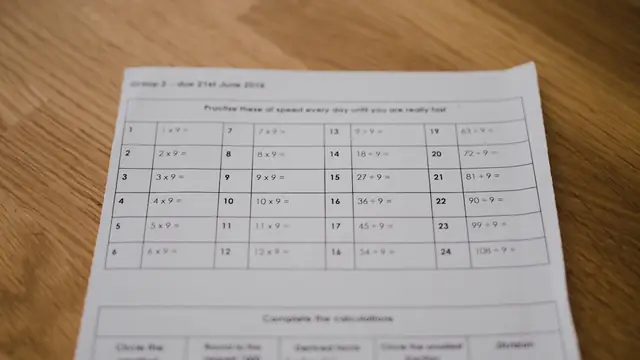
Year 4 is the middle of primary school and the year of the times tables check. Children are reading to learn now, and maths asks them to recall facts quickly so their thinking can go to harder problems.
Photo: Richard Bell on Unsplash
- 25questions in the Multiplication Tables Check
- 12 × 12the tables the check covers
- Junewhen schools run the check
- No pass markteachers use the score to see who needs help
What this year is for
- The check is short. Children answer 25 times table questions on a computer or tablet. There is no pass mark. Teachers share the score and decide whether a child needs extra help.
- Fluency has two halves. Knowing a fact such as 7 × 8 is one half. Knowing its family, 8 × 7, 56 ÷ 7 and 56 ÷ 8, is the other. Tables a child knows both ways come back faster.
- Reading changes. Children meet longer chapter books, information texts and the first real inference questions, such as how we know a character was worried.
- Writing gets more precise. Many schools introduce fronted adverbials, paragraphs and more careful punctuation this year, and your child's marking comments will mention them.
What to do at home
Little and often
Five minutes a day in mixed order works better than a long weekend drill.
Practise both ways round
Ask 6 × 7, then 7 × 6, then 42 ÷ 6. The facts connect.
Read beyond school books
Comics, football reports, recipes and chapter books all count. Ask what they would do differently in the story.
Celebrate improvement, not scores
Compare today's time with last week's. A rising line is more motivating than a number out of 25.
Practise and explore on Quizo School
- The Multiplication Tables Check What the check is and how to help.
- Year 4: the 3 and 6 times tables A five-lesson unit that builds the tables from counting in threes and sixes.
- Year 4 Maths All the Year 4 Maths units, in order.
- Year 4 English Grammar, reading and writing units.
- Official checking framework The Department for Education's description of the check.
Questions parents ask
Does the check affect secondary school?
No. Secondary places follow each school's admission rules, and the only entrance test is the 11+ for selective grammar schools. The Year 4 check helps your school spot gaps.
My child knows the tables at home but freezes on the screen.
Practise on a screen with a gentle timer, a few questions at a time. Familiar surroundings take much of the fear away.
Which tables are the hardest?
Most children find the 6, 7, 8 and 9 tables hardest. Give the 7s and 8s extra short sessions.
Was this page helpful?
Related guides
Year 4 Years 1–6
Times tables practice: ten quick questions and a map of what they know
Read the guide Years 1–6